





Specialised audiology services for babies, children and young persons (ABR, VRA, Play audiometry)
Paediatric Audiology
Specialised audiology services for babies, children and young persons (ABR, VRA, Play audiometry)
Exclusive Independent Ear & Hearing Clinic, Providing Exceptional Care to All Ages.

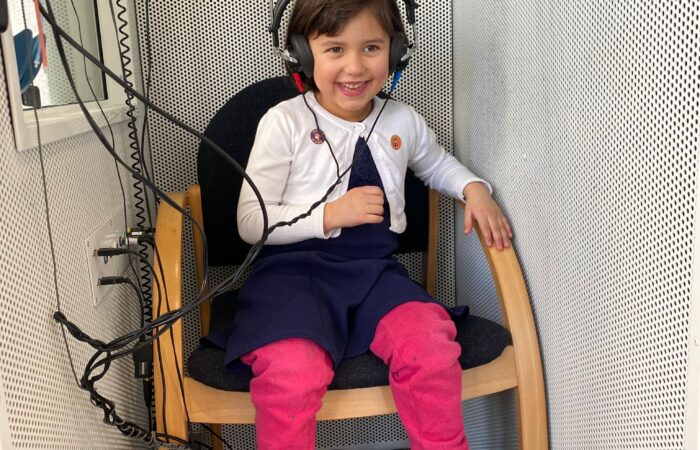
NB: Although they look like models, children in these pics are our little lovely clients, whose parents very kindly sent us these pics to be used here. Love those smiles 🙂
We provide a comprehensive, family-friendly diagnostic and habilitative audiology service for babies and children of all ages with hearing difficulties. This includes the care of children with multiple disabilities, those who are difficult to assess for any reason and for children who are at increased risk of permanent hearing loss.
We have considerable experience assessing the hearing of children of all age groups (0-16 years). When testing children’s hearing, it is important that an appropriate method is used based on the child’s age, ability and interest, and one that will give the information that is required. Some tests require children to be alert, awake, co-operative and others require the child to be quiet and still or asleep.
The tests can be put in two main categories:
Behavioural tests (subjective tests requiring child’s co-operation)
Behavioural Observation Audiometry (BOA):observing a change in physical (e.g. cessation of activity, head turn etc.) or physiological (rise in heart beat or breathing rate etc.) in response to the presentation of a measured sound stimuli. Suitable for neonates, babies and toddlers.
Visual Reinforcement Audiometry (VRA): a specialised set-up, whereby child’s response to sound is rewarded by presenting an illuminated toy or animation. It is usually performed on children from 6-30 months of age and requires two audiologists – one to distract the child and encourage him/her to respond to the sounds and other to pilot the the equipment. The child sits in the care-giver’s lap. It is usually quite good fun for the children to have this hearing test done due the reinforcement present. Some literature even suggests using a tangible reinforcement like a candy or lolipop. However, we do not know of a department in UK who have tried it.
Play Audiometry (PA): This involves modifying technique of response to the sounds presented in child’s ear, according to their ability and interest. E.g. throwing a ball in a bucket or putting a man back in the boat-everytime child hears a sound. Usual age group for this test is 3-5 years olds.
Pure Tone Audiometry (PTA): This is more of a standard hearing test for school-age children, where the child is required to press a special button every time they hear a sound.
Objective tests (computerised tests that usually do not require child to actively follow commands)
Auditory Brainstem Responses (ABR):In this test, special electrical sensors are placed on skin behind the ears and forehead to record the electrical activity of hearing nerve and brain, when a sound is presented in the ear. This is done under natural sleep and is a good way of testing hearing in babies and difficult-to-test children. This can take up to 1.5 hours.
Otoacoustic emission (OAE): In this test, a special ear phone called a ‘probe’ is placed in the ear to send a specific sound in the inner ear (known as cochlea). Turns out that our ear, if normal, will reflect some sounds back, which are carried back to the computer by the probe. The analysis of this ‘echo’ of sounds gives an idea about the functional status of inner ear, which can, in turn, indicate if the hearing is within normal range. This test is commonly used in the newborn hearing screening throughout the world. This test takes about 15-20 minutes
Tympanometry: This is a test for assessing middle ear function and/or to rule out Glue Ear(hyperlink). The total test time is around 15 minutes.
Acoustic Reflex Testing (ART): Just like our eyes have evolved to protect us from sudden bright light (or foreign body) via eye-blink reflex; ours ears are evolved to protect us from loud sounds via acoustic reflex. Interestingly, a sound presented to one ear can cause an acoustic reflex inside the other ear. The test gives important information about facial nerve, hearing nerve, auditory part of brain and perhaps most importantly, about the status of middle ear and inner ear’s specialised hair cells known as ‘inner hair cells’. Selectively damaged inner hair cells can cause a rather problematic auditory disorder known as auditory neuropathy spectrum disorder.
Yes, our clinic has state-of-art technology and expertise to see very young children. We can do objective tests on newborn babies. These are called auditory brainstem responses, otoacoustic emissions and tympanometry. They can offer information about baby's middle/inner ear and brain's hearing levels. We also perform subjective tests on infants from six months onward.
We use special games to play for doing hearing test on toddlers. Most of them actually quite enjoy those games and we get amazing comments from parents who visit us with their children:
"Jay has seen both my daughters for hearing tests and he is absolutely unbelievable. So calm and patient with the children, super engaging and makes the test so much fun. My daughters (aged 3 and 9) both felt calm, no nerves, and really enjoyed the test. He is so professional and really has a fabulous way with children"
"Dr Jindal could not have been any better. Not only was he amazing with my 3 year old son and walked him through every single thing that was happening in a situation I thought he would be chaotic, he explained everything step by step to me too so that knew what was happening, and why and the results and what that meant. My son come away feeling great about the experience and with 2 stickers and a magnet which was a lovely touch and we came away with a tv show recommendation based on my son being in a spiderman suit and Dr Jindal preparing the room with a spidey show to help get him settled. Thank you!"
Read more Testimonials here
Glue ear or middle ear effusion is a condition where sterile mucous gets stuck behind the ear drum. The part of the ear behind the ear drum (middle ear) is an air filled chamber. For a continuous supply of the air, it is connected to the nose via a tube called eustachian tube. There are a lots of moving parts in the middle ear (ear drum and tiny bones which carry the sounds to the inner ear) and the body does not like dry air. For this, middle ear cavity is lined with mucous. Extra mucous usually drains out of the chamber via eustachian tube. However, eustachian tube can get blocked due to various reasons. Cold and congestion are perhaps the major reason. This happens more frequently in children as they get episodes of congestion and also due to the fact that there eustachian tube is still developing to take the adult shape in later years.
When the eustachian tube is blocked, the mucous collects in the middle ear chamber, which affects the movement of ear drum. Hence, the sound transmission is affected. So, Glue ear is essentially a drainage issue for the body.
Glue ear is a common childhood problem that 90% of us suffer once before the age of 4. Children above 6 years old have 85% less chances of having Glue ear. By some account, Glue ear is the most common issue why parents take children to their GP’s, throughout the world. Although some of us go on to have this in the adulthood but adult Glue ear is rare and often pathological, needing medical attention.
Once the eustachian tube congestion goes away- Glue ear disappears. This happens spontaneously in most children. However, a small percentage of children either have a persistent Glue ear or more frequent episodes than others, affecting their hearing, speech/language, academics and behaviour. If the hearing issues diagnosed in subsequent audiological tests (audiometry, tympanometry and sometime otoacoustic emissions) show a significant deterioration along with the accompanying symptoms (speech, behaviour or learning issues)- it is perhaps a good reason to actively seek help for Glue ear. One of the treatment options is something called ‘grommet’. Grommet is a tiny little tube (you can perhaps fit 3-4 of those on your little finger nail), that’s fixed in the ear drum by an ENT surgeon after sucking the Glue out of the ear with a special suction device. It is a very successful operation with reports of 98% success rates. Please speak to your audiologist, GP or ENT surgeon if you are worried about your child’s hearing.
Your audiologist will perhaps monitor your child’s hearing for a few time, before discharging them from the service.
Read more:
http://www.ndcs.org.uk/family_support/-glue_ear/
http://www.nhs.uk/conditions/glue-ear/pages/introduction.aspx
http://www.nice.org.uk/guidance/cg60/-resources/guidance-surgical-management-of-otitis-media-with-effusion-in-children-pdf
Video animation: https://www.youtube.com/watch?v=gYrEh025hqU
Loud music from personal ear phones or loudspeaker, can be very harmful for the ear. Various European and American studies have shown irreversible changes in teenagers’ hearing who listened to loud music for everyday via their iPod etc. Loud noises cause a permanent ear damage. The slightly more alarming part that we do not usually realise is that they cause permanent changes in the chemical composition of nerve cell causing a wide range of effects on the body. There is a strong body of evidence suggesting that loud noises affect the brain, heart, stress level and general wellness. As a rule of thumb, if the person standing next to you can hear the song that you are playing in your ear via the earphone- it is too loud for you. If you listen to music via earphones every day, try this:
Here are 6 Steps to save hearing from loud music:
Step 1: Go in the quietest area of the house
Step 2: Put the music app on your device and plug the ear phones in your ears
Step 3: Set the volume to a comfortable level that is acceptable to you
Step 4: Ask a normal hearing person in the house, if they can hear the song you are playing from 2 feet
Step 5: If they can-reduce the volume and follow step 4. If they can’t-
Step 6. Lock the volume level of your device to this level.
The temptation will be to increase the volume in noisy environment (bus, train, tubes etc.). That is what you have to get used to if you really want protect your hearing and wellness.
Earwax, also known as cerumen, is a natural substance produced by the glands in the ear canal that helps to lubricate the ear and protect it from dust, bacteria, and other foreign objects. Here are some tips for taking care of earwax:
- Avoid using cotton swabs or other objects to clean your ears: These objects can push earwax further into the ear canal and potentially cause damage.
- Use ear drops: Over-the-counter ear drops can help to soften and loosen earwax, making it easier to remove. Note that when the ear is completely blocked with earwax, the ear drops seldom help and it needs to be removed by an expert
- Consult your audiologist: If you have difficulty with earwax, or if you experience pain, discomfort, hearing loss, or ringing in the ear, it’s important to consult your audiologist. We can examine your ear and recommend appropriate treatment, such as earwax removal using suction or irrigation.
We offer a comprehensive earwax removal service
Clinical Insight