



Hearing Care Done Properly: From Understanding Your Needs to Proven Results
(And How This Differs from other Hearing Aid Provisions in the UK)
Hearing care isn’t about buying a device. It’s about understanding how you hear, how you struggle, and what will actually help you function better in real life.
Unfortunately, much of hearing care is reduced to a quick test and a fast solution. That approach works for some people — but for many, it doesn’t go far enough.
Here’s how comprehensive, clinical hearing care really works, and how it differs from the typical high-street model.
Step 1: Understanding Your Hearing Needs — Not Just Your Hearing Test

Proper hearing care starts before any equipment is used.
We begin with a structured needs assessment, focused on your life:
- Where you struggle most (work, social settings, family conversations)
- Listening effort and fatigue
- Confidence and avoidance
- Cognitive load and concentration
- What matters most to you day-to-day
Two people with the same hearing test can have completely different needs. Treating them the same makes no clinical sense.
How this differs from others:
Consultations are often time-limited and device-focused. Needs assessment may be brief and centred on eligibility for hearing aids rather than functional impact.
Sometimes, after a proper discussion, the right decision is no intervention yet — just monitoring and advice. That’s still good care.
Step 2: Comprehensive Hearing Assessment — Beyond the Audiogram

Yes, we perform a standard hearing test (audiogram). It’s essential.
But hearing is more than detecting quiet beeps in a silent room.
A complete assessment may include:
- Pure-tone audiometry (hearing sensitivity)
- Speech testing in quiet and in noise (real-world understanding)
- Objective cochlear tests (how the inner ear is functioning)
- Middle ear assessment
- Listening effort indicators
This creates a functional hearing profile, not just a graph.
How this differs from others:
Many other services rely almost entirely on the audiogram. Speech-in-noise testing and objective measures may be minimal or absent — despite being more predictive of real-world difficulty and therefore, most important in getting the desired outcomes from hearing technology
Step 3: Clinical Decision-Making — Sometimes Doing Nothing Is the Right Answer

Once your hearing profile is complete, decisions are made based on need, function, and evidence.
Options may include:
- Monitoring only
- Education and communication strategies
- Auditory training
- Hearing technology
- A combined approach
Not everyone needs immediate hearing technology — and fitting devices when they aren’t needed often leads to frustration and poor outcomes.
How this differs from others:
Many other models of service are often device-led. The pathway tends to end with a product. In a care-led model, technology is just one option — not the goal.
Step 4: Precision Fitting Using Real-Ear Measurements (Verification)
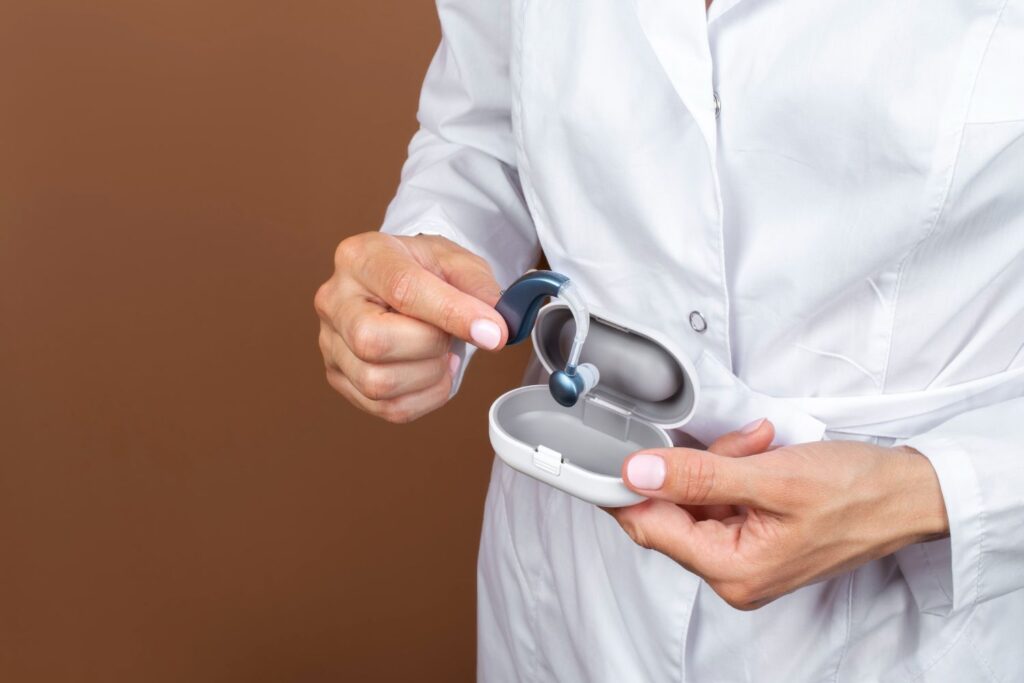
If hearing technology is recommended, fitting it correctly matters. The technology has to be optimised to your hearing and to your life for it to work for you.
We use real-ear measurements (REM) — the gold standard method that measures sound levels inside your ear canal while you wear the devices.
Why this matters:
- Every ear canal is different
- Manufacturer “first-fit” settings are estimates
- Without verification, no one knows what sound you’re actually receiving
Real-ear measurement ensures the technology delivers the right sound, at the right level, for your ears. It takes the guess work away from the scientific process it has to be.
How this differs from others:
Despite featuring in the best practice guidance across the world, REM may be optional or inconsistently used in most settings. In comprehensive hearing care, it’s non-negotiable.
Step 5: Validation — Proving That the Solution Works
Verification checks the technology. Validation checks the outcome.
We validate by:
- Repeating speech-in-noise testing
- Using outcome measures
- Reviewing real-world listening performance
- Assessing effort, confidence, and benefit
If the outcome isn’t right, we adjust. If it still isn’t right, we rethink the plan.
How this differs from others:
Success is often judged informally: “Give it time and see how you get on.” Proper care measures improvement — it doesn’t assume it. You get a consistent, scientific care from a qualified audiologist every time you visit us.
Step 6: Ongoing Care Through a Personalised Hearing Plan

Hearing care doesn’t end after fitting.
Hearing, listening demands, and cognitive load all change over time. That’s why we provide a personalised, ongoing care plan, which may include:
- Scheduled reviews
- Hearing monitoring
- Technology optimisation
- Auditory training updates
- Counselling and education
- Support as your life and listening environments evolve
Technology doesn’t maintain outcomes.
Care does.
How this differs from others:
Hearing care provision is often transactional, with follow-ups tied to sales cycles. Comprehensive care is relationship-based and long-term.
The Real Difference Isn’t the Equipment — It’s the Philosophy
Comprehensive hearing care is:
- Individualised
- Evidence-based
- Verified and validated
- Focused on long-term hearing health
And NOT
- Time-limited
- Device-led
- Transaction-focused
Both models exist. They are not the same.
The Bottom Line
If you’re looking for:
- A quick test
- A fast solution
- A product-focused experience
Anyone on your high street can provide that.
If you want:
- A full understanding of your hearing
- Decisions based on function, not assumptions
- Proven outcomes
- Ongoing, personalised care
That requires a different approach.
And your hearing is worth that difference.