





Introduction:
You couldn’t sleep last night, and your head was spinning. You couldn’t stand. Even turning your head up and down felt too hard. It can be very terrifying when dizziness appears from nowhere, especially when it interrupts simple daily activities. People who face labyrinthitis for the first time feel very scared and think like they are dealing with something serious and for a lifetime.
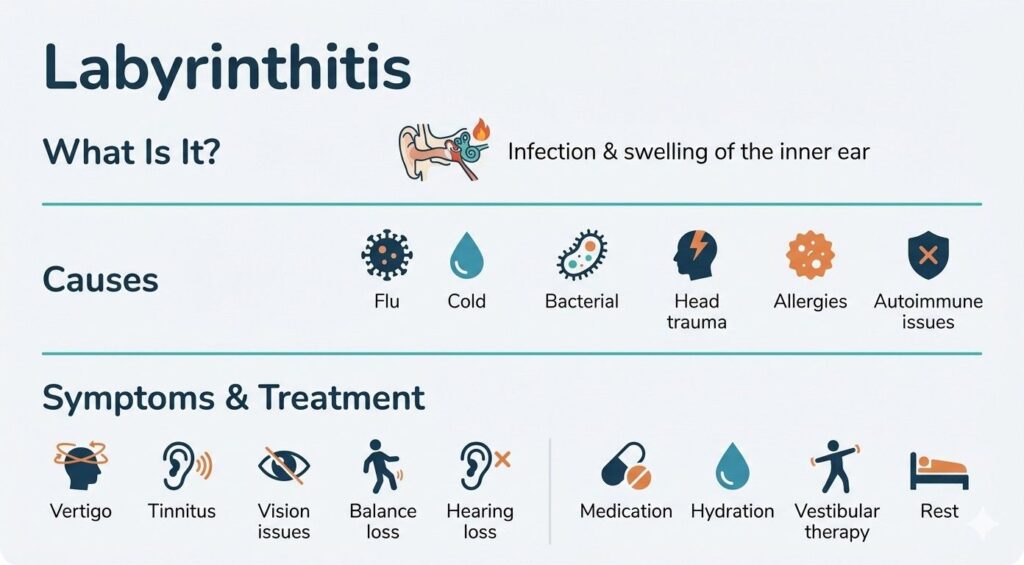
Labyrinthitis is an infection, irritation and swelling of the inner ear. It usually develops suddenly and can cause dizziness, vertigo, and hearing loss.
But the good news is that most people recover from this disease with time and with proper care and medications.
In this guide you will understand:
- What is labyrinthitis?
- Common symptoms of Labyrinthitis
- Causes of this disease
- Treatment of Labyrinthitis
- Exercises that help you from recovering.
What Is Labyrinthitis?
What Is the Inner Ear's Labyrinth?
Deep inside your inner ear there is a small but important structure called the labyrinth. It is basically a warren-like structure of tiny passages filled with fluid and sensitive nerves. Its job is to help you hear sounds and also help you stay balanced while walking, standing, or doing any other activities.
Labyrinth helps your ear to hear and balance the noises. It also helps to send messages to your brain.
The labyrinth has two main parts:
- The cochlea – It is the part responsible for hearing sounds in your ear. It converts sound vibrations into a proper indication that your brain understands as a sound.
- The vestibular system – It is a group of fluid-filled canals that help your brain detect movement, direction, and body position.
What Happens When the Labyrinth Gets Inflamed?
When the labyrinth becomes inflamed, the instructions sent to your brain become confused/disoriented. Your brain receives lots of mixed messages about movement or showing emotions.
This disease can lead to many problems, like:
- Vertigo
- Dizziness
- Nausea
- Balance problems
- Hearing problems
These problems lead to a disease called labyrinthitis.
Labyrinthitis Symptoms -What Does It Feel Like?

Common Labyrinthitis Symptoms
People who are suffering from labyrinthitis can see these common symptoms in them:
- Blurred Vision
- Balance issues
- Dizziness
- Hearing Problems
- Vomiting
- Tinnitus– Ringing or other sounds in your ear.
- Vertigo-Feels like you are spinning.
How Long Do Symptoms Last?
You generally have these symptoms in the first 2-3 days.
After some days:
- Severe vertigo (feels like spinning) generally improves in2-3 weeks.
- Balance issues also improve significantly with time.
- However, full recovery may take a while.
Some people who are young often recover quickly while people who are adults take more time to fully recover.
Labyrinthitis Symptoms vs Normal Dizziness - Key Differences
Feature | Labyrinthitis | Normal Dizziness |
|---|---|---|
Feeling | Strong spinning sensation (vertigo) | Mild light headaches or brief imbalance |
Beginning | Often sudden and intense | Usually gradual or temporary |
Duration | Can last for hours, days, or weeks | Usually lasts a few seconds or minutes |
Balance Problems | Severe difficulty walking or standing steadily | Mild unsteadiness |
Hearing Changes | May include muffled hearing or hearing loss | Hearing is usually normal |
Ringing in the Ear | Common in some cases | Rare |
Nausea or Vomiting | Frequently present | Usually mild or absent |
Trigger | Often linked to a viral or inner ear infection | Can be caused by dehydration, stress, hunger, or standing up too quickly |
Eye Movement Issues | May cause abnormal eye movements (nystagmus) | Not common |
Recovery Time | May require medication, rest, and balance exercises | Often improves quickly with rest or hydration |
What Causes Labyrinthitis?
Viral Labyrinthitis - The Most Common Cause
Mostly all cases of labyrinthitis are caused by viral infections. But some bacterial infections cause it too.
Some of the most common causes of labyrinthitis are:
- Flu or Cold
- Stomach flu
- Respiratory infections
- Mumps
- Rubella
- Measles
- Covid-19
These type of virus spreads into the inner ear and causes labyrinthitis.
Bacterial Labyrinthitis:
Bacterial labyrinthitis is less common but is more severe. It is more dangerous.
The symptoms are shown when:
- A middle ear infection spreads.
- Meningitis affects the ear
- A severe head injury can damage the inner ear.
Bacterial infections require urgent medical treatment.
Other Labyrinthitis Causes:
Other Labyrinthitis causes include the following:
- Autoimmune disorders
- Allergies
- Head trauma or injury
- Certain medications that are toxic to the inner ear.
What Is Idiopathic Labyrinthitis?
Idiopathic labyrinthitis is an inner ear disorder caused by sudden hearing loss, vertigo, etc. The term “idiopathic” also means the cause is unknown.
Doctors believe that many idiopathic cases are still related to mild viral infections.
Also, when the exact trigger is unclear, then the doctor often says that the treatment is the same.
Labyrinthitis vs. Vestibular Neuritis
What Is the Difference?
Labyrinthitis and vestibular neuritis are both the same. Both involve inner ear inflammation and cause vertigo that feels you are spinning.
Feature | Labyrinthitis | Vestibular Neuritis |
|---|---|---|
What is inflamed | The labyrinth (cochlea + vestibular system) | Only the vestibular nerve |
Hearing loss | Yes – common symptom | No – hearing is not affected |
Tinnitus (ear ringing) | Yes – may occur | No |
Main symptom | Vertigo + hearing changes | Vertigo only |
Cause | Usually viral | Usually viral |
Treatment | Similar – rest, meds, rehab exercises | Similar – rest, meds, rehab exercises |
Recovery time | Weeks to months | Weeks to months |
In other words, if you have vertigo and a hearing problem, then it is more likely labyrinthitis, and if you have vertigo with normal hearing, then it is vestibular neuritis.
How Is Labyrinthitis Diagnosed?
What the Doctor Will Check
There is no specific test for labyrinthitis. Doctors identify the disease by symptoms and hearing assessment.
Your doctor may ask you these following questions:
- Ask when symptoms started
- Review recent infections
- Examine your ears
- Test your balance
- Check your eye movements
- Perform hearing tests
When Further Tests Are Needed
Additional tests may include:
- MRI scan
- CT scan
- Blood tests
- Hearing assessment (audiogram)
- Electronystagmography (ENG)
These tests help to eliminate the following :
- Stroke
- Brain tumours
- Multiple sclerosis
- Autoimmune disease
Most people do not need major testing unless symptoms are severe.
Labyrinthitis Treatment
How Is It Treated?
Labyrinthitis usually goes away within a few weeks. Treatment can help reduce vertigo and other symptoms. Physical therapy focused on balance can be helpful for some people.
Home Care and Self-Management
For mild to moderate cases, home care plays an important role in recovery:
- Rest as much as possible
- Drink plenty of water
- Avoid sudden head movements that trigger symptoms
- Do not drive until symptoms improve
- Sleep with your head slightly elevated to reduce vertigo
- Avoid caffeine, alcohol, and salt
Vestibular Rehabilitation Therapy (VRT)
Vestibular rehabilitation therapy (VRT) is a specialized form of therapy intended to alleviate problems caused by vestibular disorders, primarily vertigo and dizziness, gaze instability, and/or imbalance and falls.
Vestibular rehabilitation therapy helps in the following:
- Improving Balance
- Reduces dizziness
- Helps the brain adapt
- Increases walking confidence
A vestibular physiotherapist usually guides these exercises.
Major organizations, including the National Health Service and Cleveland Clinic, recommend vestibular rehabilitation as an evidence-based treatment.
Surgery - Is It Ever Needed?
It is usually reserved for:
- Severe bacterial infections
- Complications involving abscesses
- Structural ear problems.
However, the majority of people recover without surgery.
Exercises for Labyrinthitis - Vestibular Rehabilitation at Home
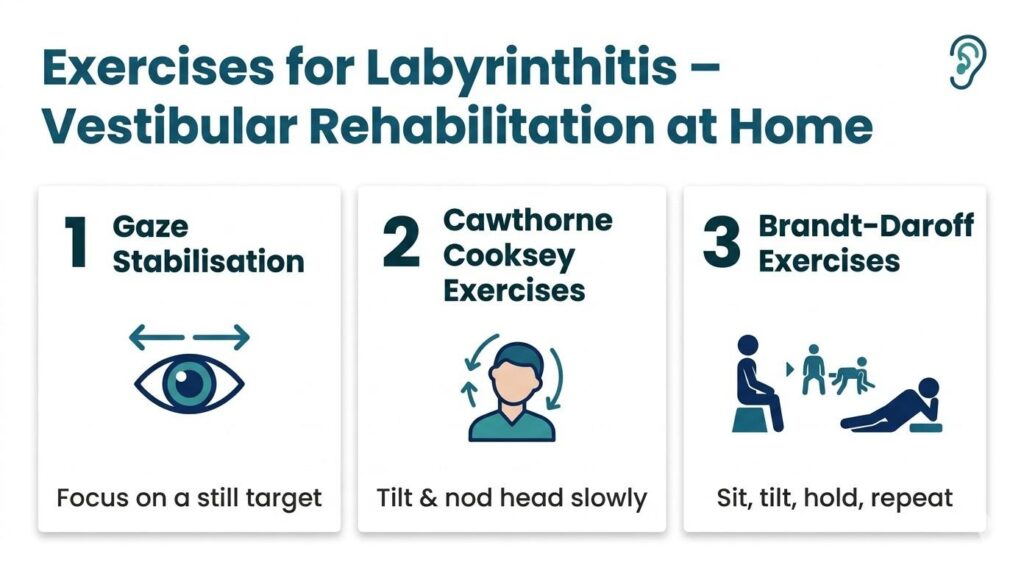
Once severe vertigo settles, there are some exercises for labyrinthitis that may help in speedy recovery.
These exercises help your brain to fight these unusual inner ear signals.
Exercise 1 - Gaze Stabilisation (Eye Focusing)
This exercise improves visual stability during movements.
- Try to sit facing to the wall
- Place a target at eye level.
- Focus the target
- Slowly move your head side by side
- Keep your eyes locked on the target
- Repeat the same again and again.
Exercise 2 - Cawthorne-Cooksey Exercises
Stage A – Sitting or Lying
- Move eyes side to side
- Look up and down
Stage B – Sitting
- Shrug shoulders
- Pick objects from the floor
Stage C – Standing
- Sit-to-stand repeatedly
- Throw a ball between hands
Stage D – Walking
- Walk across the room
- Practise turning while walking
Duration:
- Often practiced for 6-12 weeks
Temporary dizziness during these exercises is expected.
Exercise 3 - Brandt-Daroff Exercises
This exercise helps in positional dizziness.
- Sit upright on your bed
- Turn your head 45 degrees
- Quickly lie onto one side
- Hold for 30 seconds
- Return to sitting
- Repeat on the opposite side
Repeat this 5 per side twice.
How Long Does Labyrinthitis Last? (Recovery Timeline)
Recovery time depends on the basis of how severe the condition of the patient is.
Recovery Phase | Typical Timeframe | What to Expect |
|---|---|---|
Acute phase | First 1-3 days | Worst symptoms – severe vertigo, nausea, bed rest needed |
Early recovery | Days 3-14 | Symptoms begin to ease. Light activity can resume slowly. |
Continued recovery | Weeks 2-6 | Dizziness improves. Balance exercises begin. |
Full recovery | 1-3 months (most cases) | Most people return to normal daily activity |
Prolonged cases | 3-12 months | Some people, especially older adults, may need longer vestibular rehab |
When Should You See a Doctor for Labyrinthitis?
You can contact the doctor or medical professional when you see these following symptoms.
- Sudden vertigo
- Persistent dizziness
- Hearing loss
- Ringing in the ears
- Vomiting preventing hydration
- Fever with dizziness
You can admit yourself to the emergency room immediately if you have the following:
- Severe headache
- Weakness
- Facial drooping
- Numbness
- Slurred speech
- Double vision
- Difficulty swallowing
- Loss of consciousness
Can Labyrinthitis Be Prevented?
There is no known way to prevent labyrinthitis.
However, you can lower your risk by:
- Washing your hands everyday
- Staying updated on vaccinations
- Treating ear infections
- Avoid smoking
- Managing stress
- High immunity
Vaccines for measles, mumps, influenza, and COVID-19 may reduce the risk of certain viral triggers.
Living With Labyrinthitis - Day-to-Day Tips
During the recovery phase, daily life can be challenging. These following tips can be helpful:
At Home
- Move slowly – especially when getting up from a chair or bed
- Remove trip hazards like rugs and clutter to reduce fall risk
- Use handrails on stairs until balance improves
- Keep water nearby – staying hydrated helps recovery
- Wash your hands regularly.
- Do basic exercises that are recommended.
At Work
- Work from home during the first week
- Avoid jobs involving heights, driving, or operating heavy machinery until fully cleared by your doctor.
- Ask for lighter duties or flexible hours during recovery.
- Do not drive alone.
- Stay hydrated.
Mental Health During Recovery
- Talk to your doctor if anxiety is affecting your recovery.
- Gentle yoga, breathing exercises, and mindfulness can help calm the stress response
- Joining a vestibular support group can reduce isolation.
- See videos, which are entertaining, to calm your mental health.
- Spend time with your friends and family.
Living With Labyrinthitis - Day-to-Day Tips
Labyrinthitis is an infection, irritation, and swelling of the inner ear. It usually develops suddenly and can cause dizziness, vertigo, and hearing loss.
Here is a quick recap of what matters most:
- Labyrinthitis is an inflammation of the inner ear that is usually caused by a viral infection.
- Key symptoms include vertigo, dizziness, nausea, and sometimes temporary hearing loss.
- Rest, medication, and vestibular rehabilitation exercises support recovery
- Most people feel significantly better within a few weeks
- See a doctor promptly and take early treatment that leads to better outcomes.
If you are experiencing symptoms, do not delay. Speak to your doctor today and take effective measures.
Conclusion
Labyrinthitis is an infection, irritation, and swelling of the inner ear. It usually develops suddenly and can cause dizziness, vertigo, and hearing loss.
Here is a quick recap of what matters most:
- Labyrinthitis is an inflammation of the inner ear that is usually caused by a viral infection.
- Key symptoms include vertigo, dizziness, nausea, and sometimes temporary hearing loss.
- Rest, medication, and vestibular rehabilitation exercises support recovery
- Most people feel significantly better within a few weeks
- See a doctor promptly and take early treatment that leads to better outcomes.
If you are experiencing symptoms, do not delay. Speak to your doctor today and take effective measures.
Frequently Asked Questions (FAQs)
Labyrinthitis is an infection, irritation, and swelling of the inner ear. It usually develops suddenly and can cause dizziness, vertigo, and hearing loss.
No, not exactly. Labyrinthitis is a specific type of inner ear infection that affects a deeper structure than a regular outer ear infection. It is more likely to cause vertigo and balance problems than a typical ear infection.
The majority of people feel significantly better within 1-2 weeks. Full recovery, including balance, can take several months (2-3 months). In some cases, symptoms persist longer than usual, especially if treatment is delayed.
Labyrinthitis and vestibular neuritis are both the same. Both involve inner ear inflammation and cause vertigo that feels you are spinning.
Yes but only in severe cases is permanent hearing loss seen. In most cases, it is seen that hearing loss is temporary, and it is necessary to treat it well.
Gaze stabilization, Cawthorne Cooksey exercises, and Brandt-Daroff exercises. These are some exercises that help in labyrinthitis.
Yes, it can recur if it is particularly triggered by repeated viral infections. Good hygiene, vaccination, and managing stress can help to reduce the risk of recurrence.
Idiopathic labyrinthitis is a case where no clear cause can be identified. Doctors suspect most idiopathic cases are still linked to a mild viral infection that went undetected. Treatment is the same as for other types.

Consultant Audiologist
Dr. Jay Jindal
Dr. Jay Jindal, Consultant Audiologist, has 20+ years NHS and private experience.