



Overview
Ever felt like your ears are blocked, full of pressure, or need to “pop” but never do? You may be suffering from eustachian tube dysfunction. This common ear condition affects both adults and children and can cause discomfort, hearing problems, and dizziness. This guide will help you understand Eustachian tube dysfunction symptoms, causes, treatment options, and exercises that may help improve your condition.
What Is Eustachian Tube Dysfunction?
Eustachian tube dysfunction happens when the tubes that connect your middle ears to your upper throat become blocked. This can cause you ear pain, hearing issues and a feeling of fullness in your ear. Eustachian tube dysfunction usually goes away on its own in a few days. But if it doesn’t, seeking treatment is important.
A dysfunctional eustachian tube can create pressure inside your ear, and it makes sound seem muffled or causes a popping sensation. ETD is common after cough-cold, allergies, sinus infections, or during flying in a plane.
Eustachian tube dysfunction can affect anyone, but it’s more common in children. Only 1% of the general adult population has ETD.
Types of Eustachian Tube Dysfunction
There are different types of Eustachian tube dysfunction, what happens in the type, and who it triggers.
Types | What Happens | Common Trigger |
Patulous ETD | Sound travels from your nasal cavity to your ears. | Weight loss |
Obstructive ETD | Fluid builds up and causes ear pain or pressure. | Cold, allergies, infection |
Baro-challenge-indicated ETD | Ear pain and pressure occur when altitude changes. | Flying, diving, mountains |
What Are the Symptoms of Eustachian Tube Dysfunction?
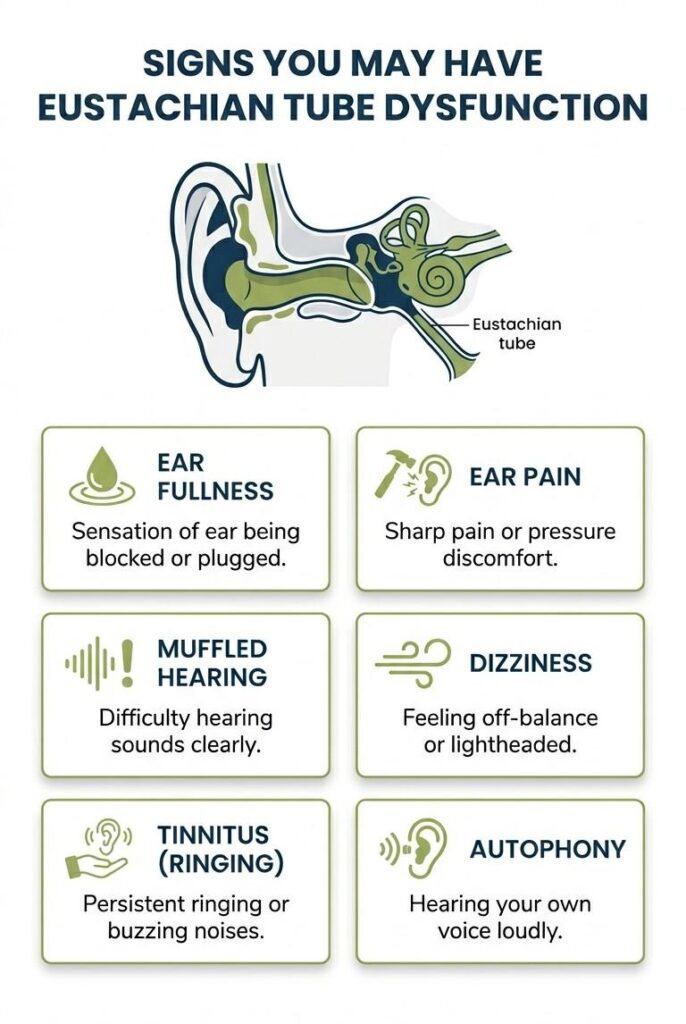
The most common ETD symptom is muffled hearing, almost like you’re underwater.
Additional Eustachian tube dysfunction symptoms may include:
- Ear fullness: A feeling of fullness in your ear.
- Popping sounds: clicking or popping sounds while yawning or swallowing.
- Hearing loss: Temporary loss of hearing after a cold or cough.
- Dizziness and balance problems: You may feel unsteady.
- Tinnitus: Ringing, buzzing sounds in your ear.
- Ear Pain: Pain can be mild or severe in your ear.
- Autophony: You will hear your own voice continuously.
When should I see a doctor?
You should see an ENT specialist when:
- Symptoms last more than 2 weeks.
- If you experience severe pain that is not bearable.
- When your hearing loss becomes worse.
What are the causes of Eustachian tube dysfunction?
The following conditions may cause inflammation that leads to eustachian tube dysfunction:
- Allergies
- Chronic acid reflux
- A virus like the common cold
- Sinus infection
- Flu
- Enlarge adenoids
Risk Factors:
- Children aged below 5
- Smokers and passive smokers
- People having obesity
- Flyers and scuba drivers
- Individuals with an ear infection.
Eustachian tube dysfunction can affect anyone but is found more commonly in children.
What Are the Complications of ETD?
In rare cases, untreated eustachian tube dysfunction can cause you hearing loss and permanent damage to your eardrum and middle ear. That’s why it’s important to tell your healthcare provider about symptoms that don’t go away after a couple of weeks.
Most of the cases improve on their own, but some don’t improve with treatment and create complications:
- Permanent hearing loss
- Ruptured eardrum
- Chronic ear infections
- Eardrum retraction
Diagnosis and Tests for Eustachian Tube Dysfunction
Your healthcare provider will ask about your symptoms and do a physical exam. They’ll check your ear canals, eardrums, nasal passages, and the back of your throat. They may run the following tests:
Test Name | What it does | Who orders it |
Endoscopy | Camera examination of throat | ENT Specialist |
Audiometry | Hearing loss | Audiologist |
Physical Examination | Checks ear canal | GP or ENT |
ETDQ-7 Questionnaire | Measures ETD symptoms | ENT or clinic |
Tympanometry | Measures middle ear pressure | Audiologist |
These tests help your healthcare provider understand what’s causing your Eustachian tube dysfunction and choose the right treatment. Learn more about the diagnostic tests available at Audiology Planet.
Management and Treatment of Eustachian Tube Dysfunction
ETD can go away on its own, so treatment isn’t always necessary. But you might need treatment if your symptoms last for more than two weeks.
Eustachian tube dysfunction treatment depends on the cause and the severity of your condition. Treatments may include home remedies, medications, or, in severe cases, surgery.
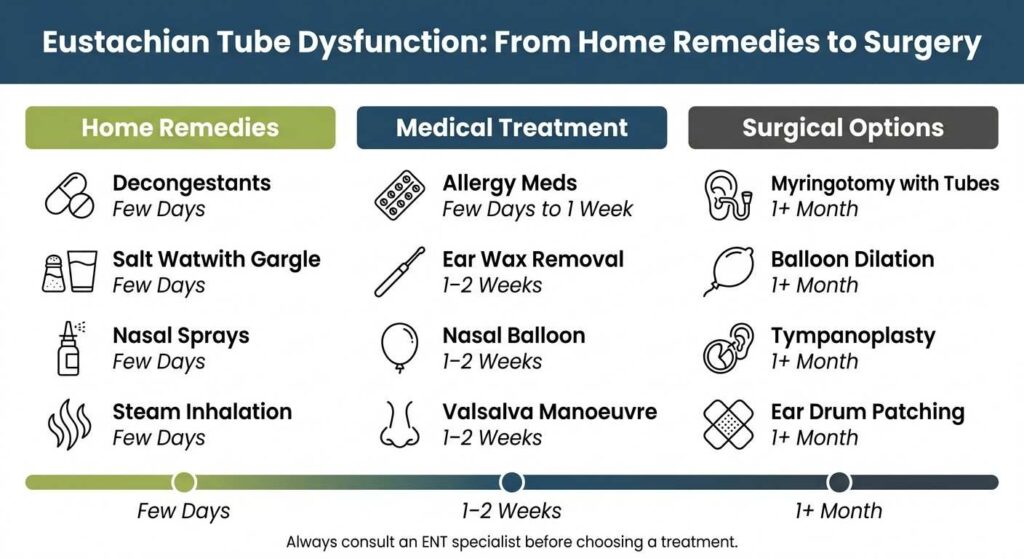
Home Remedies for Eustachian Tube Dysfunction
You can try these home remedies for ETD to recover fast.
- Yawning frequently
- Chewing gum
- Swallowing
- Use a saline spray to clear out nasal passages.
- Warm compress on the ear.
- Steam inhalation.
Possible Medical Treatments
If you consult a doctor, then the following treatments he will recommend to you:
- Decongestants
- Antihistamines
- Nasal steroid sprays
- Antibiotics for bacterial infection
- Auto-inflation devices such as Otovent
How Soon After Treatment Will I Feel Better?
It depends on the type of treatment you have. It takes about three to four weeks to heal after myringotomy. People who receive eustachian tuboplasty generally recover in about 24 hours.
Treatment | Expected Recovery |
Home Remedies | A few days to 2 weeks |
Antihistamines | 1-2 weeks |
Nasal sprays | 2-4 weeks |
Ear tubes | Immediate relief |
Balloon dilation | Days to weeks |
Eustachian Tube Dysfunction Exercises
The following are Eustachian tube dysfunction exercises that are commonly recommended by ENT specialists.
Note: You should stop immediately when you feel pain.
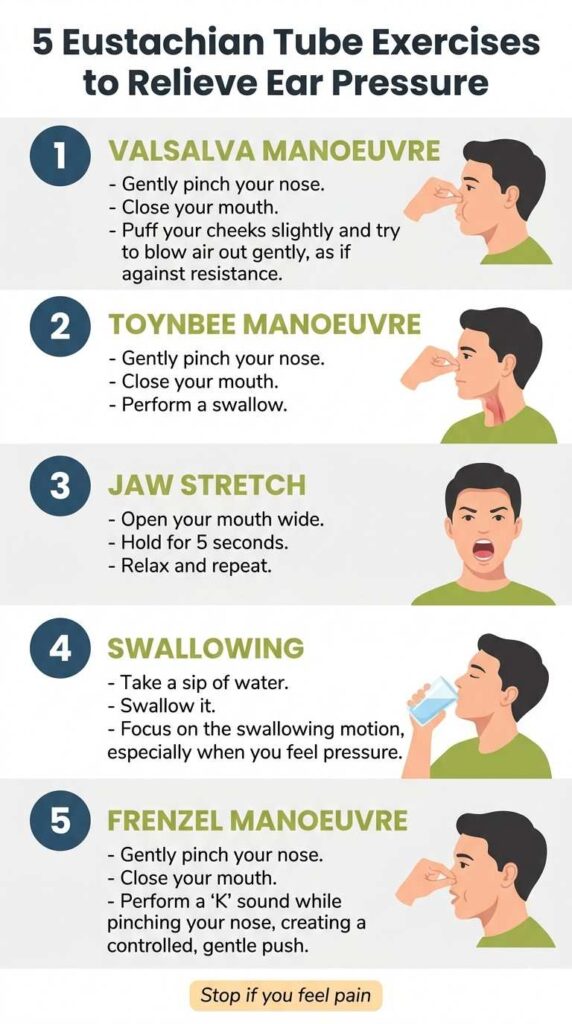
Exercise 1- The Valsalva Manoeuvre
- Close your mouth
- Pinch your nose
- Exhale gently through the nose.
- Feel a small pop in your ears.
Repeat 2-3 times daily.
Exercise 2- The Toynbee Manoeuvre
- Pinch your nose
- Swallow water slowly
- Repeat several times
Helpful during flights and pressure changes.
Exercise 3- Jaw Stretching
- Open your mouth wide like a yawn.
- Hold for 5 seconds
- Relax slowly
Repeat 5 times.
Exercise 4 – Swallowing Exercise
- Tilt your head slightly back.
- Swallow repeatedly
- Return the head to the normal position.
Perform 3 times daily.
Exercise 5 – Frenzel Manoeuvre
- Close your mouth and nose.
- Push the tongue upward.
- Create gentle pressure.
Often used by divers.
Surgical Treatment for Eustachian Tube Dysfunction
Surgery is usually considered only when symptoms are severe or long-term. The goal of this treatment is to bypass your eustachian tubes and address ventilation problems in your middle ears. This restores hearing issues and other symptoms. Surgical options for eustachian tube dysfunction include:
- Myringotomy: Your surgeon makes a small incision (cut) in your eardrum to drain the fluid from your middle ear. In adults, the incisions usually stay open long enough for the swelling in the eustachian tubes to resolve.
- Ear tubes: Sometimes, surgeons place ear tubes into the incisions during myringotomy. These tubes provide proper middle ear ventilation for up to one year. Typically, the tubes fall out over time, and your eardrum heals.
- Balloon Dilation: This involves expanding your eustachian tubes with a balloon. This minimally invasive procedure may provide long-term relief.
Surgical Comparison
Procedure | Best For | Recovery |
Ear Tubes | Children with fluid build-up | 1-2 days |
Balloon Dilation | Chronic ETD in adults | Few days |
Adenoid Removal | Enlarged adenoids | 1-2 weeks. |
Prevention
How to Reduce Your Risk of ETD?
Here are some precautions you can take to reduce the risk of ETD.
- Treat allergies early
- Avoid smoking
- Stay hydrated
- Manage acid reflux
- Avoid inserting cotton buds into ears.
- Chew gum during flights.
- Use nasal sprays if prescribed.
ETD and Flying: What You Need to Know
ETD and flying are similar and connected because of the change in altitude that affects ear pressure.
Before Your Flight: How to Protect Your Ears with ETD
- Use antihistamines if you have allergies.
- Avoid flying with severe colds.
- Use nasal spray if recommended.
During Your Flight: Tips to Relieve ETD Ear Pressure
- Chew gum during take-off and landing.
- Stay awake during descent.
- Try the Valsalva maneuver.
After Your Flight: How to Treat ETD Symptoms at Home
- Use steam inhalation.
- Apply a warm compress.
- See a doctor if symptoms last over 48 hours.
Also read related article: Why Your Ears Hurt on a Plane, and The Simple Tricks to Stop It
Living With Eustachian Tube Dysfunction
If eustachian tube dysfunction causes severe pain, or if symptoms last longer than a couple of weeks, make an appointment with your healthcare provider. Living with these feels challenging and frustrating, but many people improve with regular care.
Daily Tips to Manage Eustachian Tube Dysfunction Symptoms
- Perform ear exercises every morning.
- Avoid exposure to loud sounds.
- Keep track of things that trigger the symptoms.
- Take less stress.
How I Cured My Eustachian Tube Dysfunction
People often see improvement in them using these:
- Treating allergies consistently.
- Doing daily Valsalva exercises.
- Using saline rinses.
- Quit smoking
- Losing weight.
- Improving diet.
What Problems and Disorders Can Happen with the Eustachian Tube?
The eustachian tube plays an important role in balancing the ear pressure and draining fluid from the ear. When the tube does not work properly, several ear-related problems can develop. Some conditions are less severe, while others are more severe, and they may lead to long-term hearing complications.
What Problems Can Happen with the Eustachian Tube?
- Blocked eustachian tube: The most common type of ETD is a blocked eustachian tube that causes pressure, muffled hearing, and discomfort.
- Patulous dysfunction: the tube stays open, which makes your voice louder inside your head.
- Barotrauma is caused by pressure injury from flying, diving, or changes in altitude.
- Glue ear: The inner fluid becomes locked behind the eardrum for a long period.
What Disorders Are Related to the Eustachian Tube?
Related Condition | Connection to ETD |
Otitis Media (Middle Ear Infection) | Fluid trapped by blocked tube becomes infected |
Glue Ear | Thick fluid in middle ear; very common in children |
Cholesteatoma | Skin grows abnormally due to chronic negative pressure |
Tinnitus | Pressure changes in the middle ear cause ringing |
Barotrauma | Rapid pressure change injures middle ear structures |
Common Misconceptions About Eustachian Tube Dysfunction
Myth | Fact |
ETD always needs surgery | Most cases resolve with home remedies or medication. Surgery is a last resort. |
ETD only affects children | Adults get ETD too — especially those with allergies, reflux, or who fly often. |
Popping your ears too often damages them | Gentle pressure equalisation (like the Valsalva) is safe when done correctly. |
ETD goes away by itself — no treatment needed | Mild ETD can self-resolve, but untreated chronic ETD can lead to hearing loss. |
Cotton buds help clear ETD | Cotton buds should never be put in the ear. They can push debris deeper and cause damage. |
There is no cure for ETD | Many people fully recover with proper treatment, exercises, and lifestyle changes. |
Also read related articles: Woke Up With Muffled Hearing in One Ear? Here’s What It Could Mean
Conclusion:
Eustachian tube dysfunction (ETD) usually isn’t dangerous. But if left untreated, it could lead to serious issues like hearing loss, tinnitus or damage to your eardrum and middle ear. If you notice that symptoms don’t go away on their own in a week or two, it’s important to schedule a visit with your doctor. They will help you to guide and treat you.
Frequently Asked Questions
Yes, Mild eustachian tube dysfunction resolves on its own within 15-20 days. But in severe conditions, you should consult the doctor.
Mild ETD may last a few days to weeks, while in severe cases, it can continue for months without treatment.
The fastest way to relieve eustachian tub dysfunction are Yawning, swallowing, chewing gum, etc. may provide quick temporary relief.
Usually, ETD is not dangerous, but if you do not recover from this disease in 2-3 weeks, then you should consult a doctor and in untreated cases, it can lead to hearing problems and infections.
Yes, Eustachian tube dysfunction can cause tinnitus, as pressure inside the ear can cause and trigger ringing or buzzing sounds.

Consultant Audiologist
Dr. Jay Jindal
Dr. Jay Jindal, Consultant Audiologist, has 20+ years NHS and private experience.