



Your friend is munching on chips; you hear the annoying noise, and suddenly you feel the urge to snatch the packet and throw it. Anger is raging inside you, and you feel like shouting. Well, that is not normal; you might have misophonia.
If certain sounds trigger you and you get angry, you are not overreacting. You have the condition of misophonia. It is a real neurological condition that affects your brain’s reactions to specific sounds.
Let’s see a complete breakdown of this condition, its symptoms, causes, tests, and available treatment options.
What Is Misophonia?
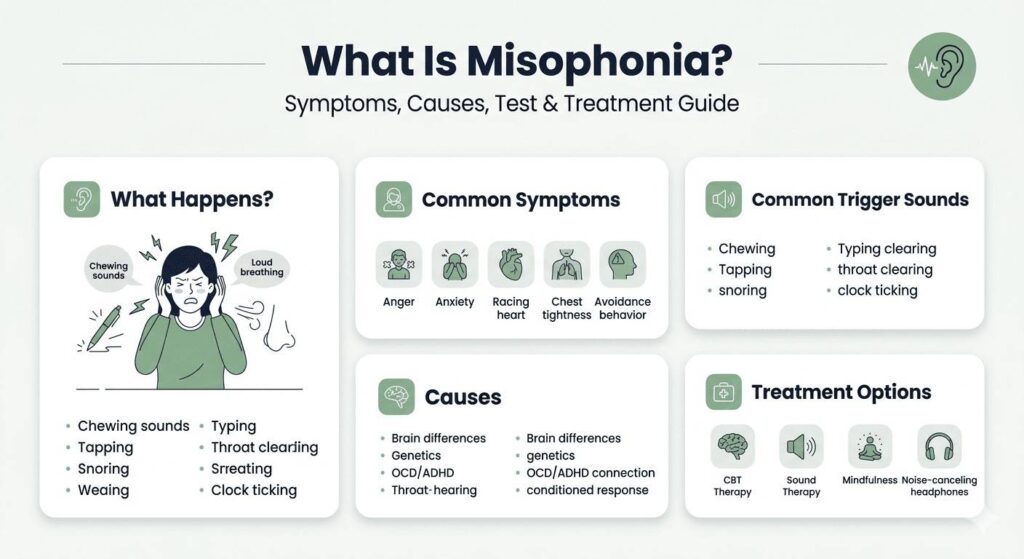
Misophonia is a medical condition in which some specific sounds trigger intense physical and emotional reactions. This term comes from the Greek words miso, meaning hatred, and phonia, meaning sound. It was first identified and recognised in 2001 by researcher Pawel Jastreboff.
It is often referred to as a condition of decreased tolerance to specific sounds or the stimuli associated with them. It is officially not listed in the DSM-5 yet, but this condition is widely recognised by medical professionals and researchers globally.
Research says that approximately 1 in every 5 people may be affected by this condition at some point in their lives. It is more common in women, and it often begins in early teens, between the ages of 9 and 13.
Misophonia vs. Similar Conditions
The points to remember while distinguishing between misophonia and other hearing-related conditions.
Condition | What It Is | Main Trigger | Emotional Response |
Misophonia | Decreased tolerance to specific sounds | Specific sounds (chewing, breathing, tapping) | Rage, disgust, anxiety |
Hyperacusis | Oversensitivity to overall loudness | Loud sounds in general | Pain, discomfort, fear |
Phonophobia | Fear of sounds or voices | Loud or unexpected sounds | Fear, panic, avoidance |
Tinnitus | Phantom ringing/noise in the ears | Internal — no external trigger | Distress, anxiety, sleep disruption |
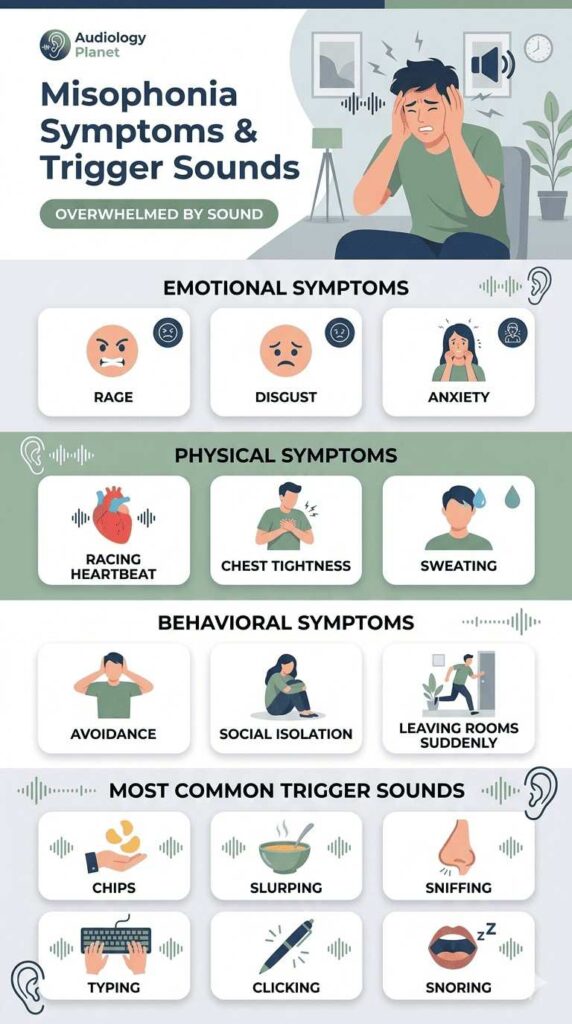
Misophonia Symptoms
The misophonia symptoms can vary from person to person. Their emotional, physical, and behavioral responses can be completely different. In this condition, a simple irritation can turn into full-blown rage and anger.
Emotional Symptoms
- Anger: A sudden, impulsive feeling that seems impossible to control.
- Disgust: A strong sense of disgust, even in the voice of someone you love.
- Anxiety: Extreme tension and overthinking.
Physical Symptoms
- Racing Heart: A sudden increase in heart rate when exposed to a trigger.
- Chest Tightness: A feeling of pressure, contraction, or restriction in the chest area.
- Skin Temperature: A sudden rise in the body temperature.
Behavioural Symptoms
- Avoidance: Avoiding people and changing daily routines to avoid sounds.
- Escape Urge: A strong desire to leave the place or distance yourself from everyone.
- Social Tension: Difficulty in relationships or at work because of isolation.
Sound Category | Common Examples |
Eating & drinking | Chewing (especially with mouth open), smacking lips, slurping, gulping, crunching crisps |
Breathing | Heavy breathing, sniffling, snoring, nose blowing |
Mouth & throat | Throat clearing, coughing, loud yawning, whistling |
Repetitive actions | Pen clicking, finger or foot tapping, loud typing, leg jiggling |
Environmental sounds | Clocks ticking, dripping water, toilet flushing, rustling plastic bags |
Visual triggers | Watching someone chew with mouth closed, seeing repeated foot tapping or hand movements |
What Causes Misophonia?
We fully don’t know the misophonia causes yet, but here are some assumptions:
Brain Differences
fMRI research, such as the 2017 Newcastle University study, shows that the part of the brain that links emotions to sounds is active in the people with misophonia. It is like a fire alarm wired to the wrong smoke detector.
Genetics
Early evidence suggests that it is usually seen that the condition may run in families. At least one genetic mutation has been identified, though more research is needed to confirm these links.
Co-occurring Conditions
Misophonia often appears alongside other conditions like OCD, ADHD, autism spectrum disorder, or tinnitus. While these do not cause misophonia, they have been frequently seen as correlated.
Conditioned response theory
With time, the brain may ‘learn’ to associate a specific sound with a threat, creating an automatic emotional response. Like, we become alert when we hear a police siren.
Misophonia Test: Could You Have It?
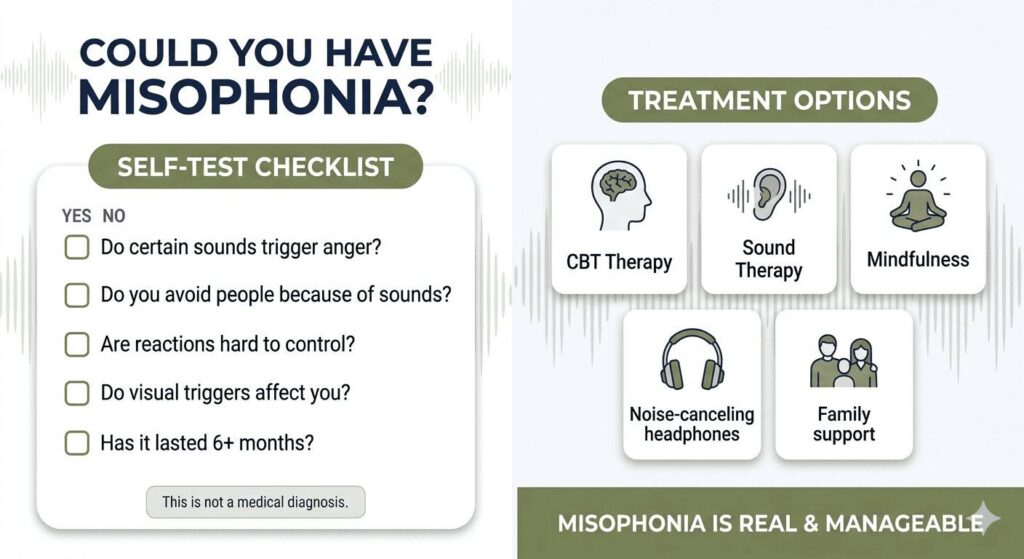
There is sadly no formal clinical test for misophonia yet. But tools such as the Amsterdam Misophonia Scale (A-MISO-S) are used by medical professionals to measure symptom severity. Here is a mysophonia test for you:
Self-Assessment Checklist
Answer YES or NO to the following questions:
- Do certain sounds cause you to feel sudden, intense anger or rage?
- Do you feel these reactions are out of proportion to the situation?
- Do specific sounds (not all loud sounds) trigger your reaction?
- Have you changed your behavior to avoid these sounds?
- Do your reactions cause tension in relationships or at work?
- Do visual triggers also provoke the reaction?
- Do the reactions start quickly and feel hard to control?
- Have these reactions been happening for 6 months or more?
Interpretation: Answering “YES” to 3 or more questions suggests that your symptoms are maybe worth discussing with an audiologist or psychologist.
Disclaimer: This checklist is for informational purposes only and is not a clinical diagnosis.
Treatment for Misophonia
There is no established cure yet, but that does not mean that there is no treatment for misophonia. Then how to treat misophonia? Here are some treatments that can significantly improve your quality of life.
Cognitive Behavioural Therapy (CBT)
CBT is currently the most fact-checked treatment. It helps you rework on your emotional response to trigger sounds and is often the first-line recommendation.
Sound Therapy
Audiologists often use sound therapy or Tinnitus Retraining Therapy (TRT). This therapy involves using subtle background noise to gradually reduce your sensitivity to specific triggers over time.
Practical Coping Tools
Many people manage daily symptoms using noise-canceling headphones. It does not treat the underlying condition but is highly effective for day-to-day management.
Treatment | Best For | Delivered By | Evidence Level |
CBT | Changing emotional responses to triggers | Clinical Psychologist | Strong |
DBT | Managing intense emotional reactions | Psychologist / Therapist | Moderate |
Sound Therapy / TRT | Reducing sound sensitivity over time | Audiologist | Moderate |
Mindfulness | Reducing daily stress and anxiety | Therapist / Self-practice | Emerging |
Medication (SSRIs) | Co-occurring anxiety or OCD | Psychiatrist / GP | Limited (indirect) |
Coping Tools | Day-to-day symptom management | Self-directed | Practical / Widely used |
How I Cured My Misophonia: Emma’s Story
Emma, a 29-year-old teacher, always avoided the crowded staffroom for years because of the sounds of her colleagues eating and chatting. She felt isolated and constantly on edge. Then how did she manage her misophonia?
After 12 sessions of CBT, Emma learned some techniques to regulate her body’s automatic alarm reaction. The sounds still bother her, but they no longer trigger uncontrollable anger.
Key Takeaways
- Management is possible till a full “cure” is available.
- Professional help cannot cure but can provide some tools to handle social situations.
- Consistency in therapy is the key to long-term improvement.
Practical Daily Tips
Living with misophonia can be really tough and challenging, so here are some tips to help you:
For You
- Use background music or white noise in quiet environments.
- Practice mindfulness to reduce your overall physical stress levels.
For Family
- Keep them updated about your condition so that they are familiar with it.
- Be vocal about your personal space with your partner and family.
At Work
- Request a desk in a quieter area or use headphones if allowed.
- Be open with HR about your condition for reasonable adjustments.
Conclusion
Misophonia is a tough and challenging condition, but it is manageable. Just remember that you are not alone, and your reaction is a recognized physical and emotional response. If you identified with the symptoms in our self-test, consider reaching out to a professional to discuss your condition today.
Also Read Related Articles:
References:
- Schröder, A.et.al. (2022). Consensus Definition of Misophonia.
https://pmc.ncbi.nlm.nih.gov/articles/PMC8969743/ - Kumar, S.et.al. (2017). The brain basis for misophonia.
- Jastreboff, P.J. & Jastreboff, M.M. (2001). Hyperacusis.
- Cleveland Clinic, Misophonia.
- NIMH, anxiety, and co-occurring conditions.
Frequently Asked Questions
Misophonia is a recognized neurological condition; it is not you being dramatic or overreacting. Research using fMRI shows that people with this condition have an extremely sensitive brain response to specific sounds that others easily ignore.
While it is rare for misophonia to disappear entirely on its own, many people have seen that it becomes much more manageable with age. Early interference through therapy can prevent symptoms from worsening and help you regain control over your reactions.
There is a high correlation between misophonia and conditions like ADHD and autism, as well as OCD. While having one does not cause the other, they might co-occur because they both originate from the brain's unique way of processing.
Cognitive Behavioral Therapy (CBT) is considered to be the most effective treatment to date for changing your emotional response to triggers. Dialectical Behavior Therapy (DBT) and sound therapy are also highly successful for those needing help with their emotions.
Without any treatment, misophonia can sometimes get extreme because the brain becomes more hyper-aware of triggers over time. However, with proper treatment, most people find that they can significantly reduce the impact of the condition as they get older.
Yes, misophonia frequently develops in childhood or the early teenage years, generally appearing between the ages of 9 and 13.

Consultant Audiologist
Dr. Jay Jindal
Dr. Jay Jindal, Consultant Audiologist, has 20+ years NHS and private experience.